

Worldwide, as greenhouse gas emissions are still increasing and temperatures are rising across land and sea, the latest CSIRO and Bureau of Meteorology State of the Climate Report highlights that Australia’s climate is also continuing to warm.
Australia’s land and seas are now at record levels of heat. On land, Australia has warmed by an average of 1.51°C since 1910 and our oceans have heated up by 1.08°C on average since 1900.

As Australia keeps warming, extreme heat events will become more frequent and more extreme: extreme fire weather occurs more frequently and is more intense; sea levels are rising; marine heatwaves are becoming more intense and frequent; and oceans are getting more acidic. All of these come with serious consequences for Australia’s environment and communities. Extreme heatwaves cause more deaths in this country than any other natural hazard, peaking at 830 heat-related deaths during Australia’s hottest year in 2019. Globally, 2023 was the hottest year on record to date.
Almost all (90%) of the extra heat trapped by greenhouse gases has gone into the oceans. Oceans are getting rapidly hotter. This matters because ocean heat strongly influences weather patterns in Australia. Australia’s oceans are warming faster than the global average, and the oceans off south-east Australia and the Tasman Sea are a particular hotspot and are now warming at twice the global average. As the seas warm, they expand. This thermal expansion is one of the main contributors to rising sea levels. Around Australia, sea levels have risen 22 centimetres since 1900 – with half of that since 1970.
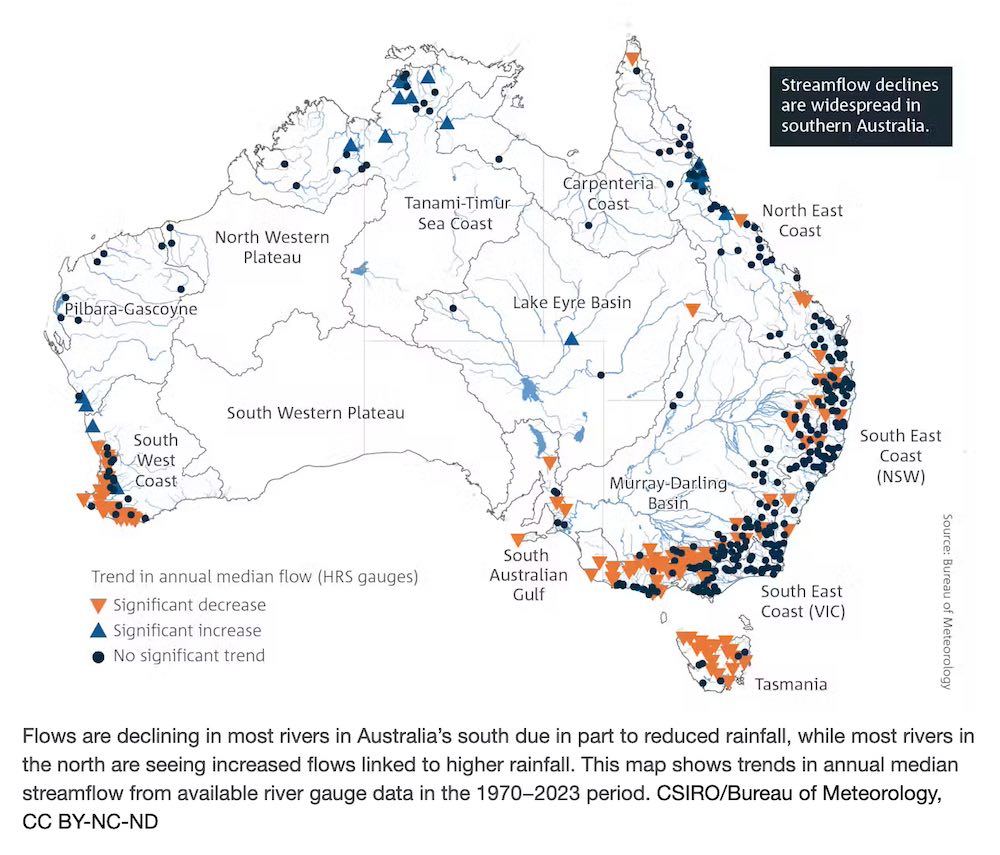
Climate change is driving a major divergence in where rain falls in Australia. In northern Australia, average wet-season rainfall is now about 20% higher than 30 years ago, but in southwestern Australia, rainfall in the cooler, growing-season months has declined 16%, and in the southeast by 9% in recent decades. More rain in these regions now falls in heavy, short-lived rainfall events.
These changes are also reflected in our rivers, with significantly lower flows for about one third of the gauges in the south. Australia-wide, only 4% of our river gauges are measuring increased flows, and almost all of these are in the north.

For the world as a whole, 2024 will be world’s hottest year on record, EU scientists say